Eight hotel executives discuss the best ways to optimize the bottom line
of experiential hospitality.
Editor’s note: This
roundtable was sponsored by Actabl, which participated in the discussion but
had no influence on the editorial content.
LOS ANGELES — Ben Seidel, president and CEO
of Real Hospitality Group, said his company manages over 100 branded and
independent hotels. Last year it developed a novel approach to help employees understand what it's truly like to be a customer of those brands.
In October, Real Hospitality launched a program for the
orientation of new properties where employees were enrolled in the loyalty
program for that hotel brand. On their 90-day review, assuming it’s positive,
those employees were given 25,000 points in that loyalty program.
That meant employees often had more points than the customers they took care of and would get all the messaging about the experiences the brands offered.
“They
get the emails that the other members get. They get all the offers. They get
double-point offers and things like that — everything the customers they’re
servicing are getting — they’re now a part of it. That’s been a huge
game-changer,” Seidel said.
Seidel
said that one of the unintended consequences is that the employees now feel
bigger than just the hotels they work in and even bigger than the company they work for. They now feel like they are an ambassador of the overall hotel brand, the experiences and the hotel company. At the end of the day, that changed perspective revealed itself in how they treat their "fellow customers" — the hotel’s guests.
“What’s
neat is to see the attention to the customer’s experience that they encounter
because [the employees] are part of that customer base,” added Seidel, who was part of a roundtable about experiential hospitality and how it could help a hotel's profitability and return on investment. The event in January was sponsored by Actabl and held during The Americas Lodging Investment Summit (ALIS) in Los Angeles.
The participants were Paul Bennie, vice president of
strategic accounts, Actabl; Barrett Busscher, vice president of asset
management, Electra America Hospitality Group; Krystal England, chief
investment officer, TMGOC Ventures; Michael Heaton, president, Waterford Hotel
Group; Ferit Ferhangil, CEO, Waramaug Hospitality; Daniel del Olmo, president,
hotels and restaurants, Sage Hospitality Group; and Brian Waldman, chief
investment officer, Peachtree Group. Rob Schneider, managing editor of Hotel
Investment Today, moderated the session.
The
executives discussed:
- What
is profitable and what’s not?
- How
data, technology and benchmarking can transform experiences into higher ROI.
- Which
experiences are the next must-haves?
- How
do owners, operators and developers keep it fresh?
Hotel Investment Today (HIT): In terms of experiential, what is
working? What’s profitable and what’s not?
Daniel del Olmo: Let’s start with what
doesn’t work. What doesn’t work is one size fits all, particularly when it
comes to the experiential environment. People looking for unique experiences,
particularly those guests who are used to unique experiences, can differentiate
between a pretend lifestyle experience and a real, authentic, genuine
experience where the hardware is just one component. But the software, through
the service delivery, is essential… We take an
approach where one size fits one versus one size fits all.
Michael Heaton: We have a very
different customer coming out of COVID. Experiential is about memorable
experiences up and down the spectrum of hotel classes. We’re talking
profitability. So, I go straight to payroll and labor. Your associates are doing
things differently now. They engage with the guests before they get there,
while they are there, and after they leave. It’s very different from what it
was traditionally, requiring a transformational change in how we train. It has to start with programming, messaging, training and education, and that
messaging has to align with your marketing efforts, which are also all
changing… Those experiential, memorable experiences will not just be reserved
for upscale hotels; they will be expected up and down the hotel tiers, and operators
will have to adjust significantly to that.
Brian Waldman: It all comes down to
ROI, and looking at the ROI on specific projects… You can do little things to
connect with the guests, whether it’s artwork, retail experience, or something
to help drive and connect with the community. You can throw a tremendous amount
of money at hotels, and when you’re looking at those hard-branded assets, the
brands do a really good job with their prototypes.
We see a lot of owners want to make changes to their assets based on what they
want. There’s not necessarily ROI on it. In a number of our hotels,
particularly with the lifestyle hotels, there are little things that we can do
to help connect with the community… No one wants to eat at the old food and
beverage in hotels, at the branded restaurant in the hotel. I don’t necessarily
need that. If I have at least a restaurant, that’s one thing. Otherwise, get
people out of my hotel. Get them out into the neighborhood and get them to
those cool restaurants. They can still have that experience without having the
cost of it.
Ferit Ferhangil: We started looking at
the human touch in our hotel business, even though they’re managed by
third-party management companies, and looking at the customer’s experience even
in hard-branded products. In select-service hotels, one of the things that we
started doing is having the front desk staff learn about the great restaurants
in the neighborhood because when you’ve recommended a good restaurant to a
guest, you’ve touched them with something that they’ll remember and you’ve made
that stay memorable... But something that has nothing to do with the hotel is
just the human interaction.
Similarly, in our full-service hotels, we started
looking at what our customers’ first and last point of contact was: the valet. Yet,
in most of our properties, it was outsourced. Some people were not trained and
were being paid the minimum amount. So, we started putting certain requirements
for the valet regarding their training and how they appeared. Even if a
customer had a bad experience, for some reason, at the front desk as they were
leaving, if the valet smiled at them and said something nice to them, their
departure was improved.
Paul Bennie: Sometimes, when we talk
about our guests, we will say the guest is what makes us profitable. Actually,
the guest is what brings us revenue… What makes us profitable is what we’re
talking about. It’s taking the guests, trying to take the dollar they gave us,
and translating that to the bottom line. In the process of doing that, we’re
going through the motions of providing these experiences to them at a high
value. Technology enables some of that to happen, where they can have this high
value and high touch and feel like they’re being taken care of and feel like
they’re being recognized and empowered… These high-touch experiences are
helping to enable that to flow down to the bottom line to where we can be
profitable.
HIT: How do owners, operators and developers keep it
fresh and profitable?
Heaton: Another post-COVID observation is the world of beverage has changed considerably… We looked at our
beverage offerings and asked ourselves, what is the parity with our room
brands? We found there wasn’t always parity, and guests would pay a premium to
stay at a property. We didn’t want to be in a situation where they must buy
down to enjoy our lounge or restaurant. It really changed the discussion on how
we present it and how to enhance the guests’ experience at different income
levels at different hotels… Ultimately, that approach, changing our
inventories, pricing, and everything we do for the betterment of the guests,
will lead to subtle design changes in future renovations because there are all
kinds of visibility issues for bottle placement and top-tier. So, now I have a
critical eye when I look at lounges all the time, and I’m always finding things
I think can be enhanced.
Krystal England: One of the things that comes to my mind is
something that gets to be more exclusive, but not necessarily expensive to
provide, and being able to provide something really interesting to the guests,
but not a high cost. If you can offer guests the ski resort’s first tracks on
the mountain at 7:30 a.m., they can be very excited about that. That’s not a
high-cost item, but it is memorable for that guest.
Waldman: We went around the
table, and everyone talked about guest touch and how to improve the guest
experience. One thing that I didn’t hear was technology. What you’re hearing in
the industry today is how we will use technology to replace people. I like the
idea of technology to support the guest experience. But ultimately, it’s our
people that create that experience. It’s our people that our guests connect
with. If you remove those people and just put technology in place, you lose a
lot of that connection and become a commodity.
HIT: How can data, technology and benchmarking help
transform these experiences into higher ROI?
Barrett Busscher: AI becomes a copilot.
It enables people to do their jobs better and makes things easier; I don’t
think it will be taking jobs, but helping people create higher-touch
experiences.
Ferhangil: I want to touch upon
the cost side of our business with technology and using AI as tools to enable
or empower our managers. When you went to the doctor, you’d have five pages of
bloodwork, and the doctor would go through every line. Now your bloodwork comes
out, and two lines are in bold, which are the only ones that are outliers, and
that’s the only thing the doctor looks at. That saves the doctor five minutes
per patient… I’ve been talking to the various management companies that manage
our hotels and ask them to generate the P&Ls for GMs and regional managers
to highlight items that are out of norm or out of benchmark, and bold them. But
they’re not doing it… All the tools are available, but the mindset is not
there. That would focus teams so much better on being more productive.
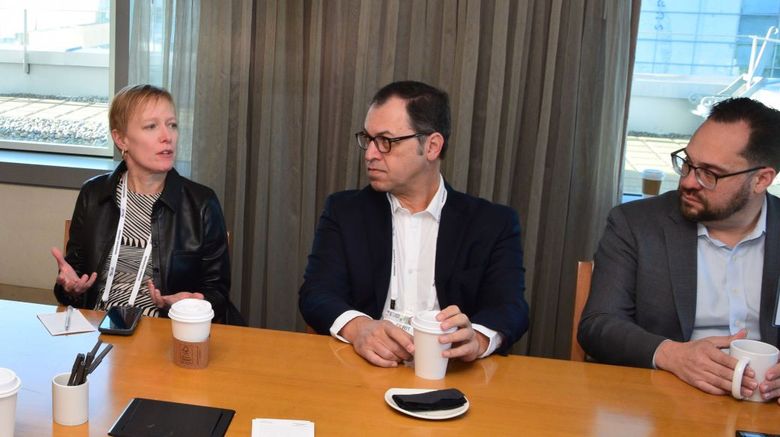
(From left:) Krystal England, Ferit Ferhangil and Brian Waldman.
HIT: How do you leverage experiential design to control
intervals between replacements?
Busscher: It’s creating unique
spaces, lobbies and public spaces that are more timeless. We just finished a
renovation. We did all of the public spaces — the lobby and the restaurant, but
we didn’t touch the rooms. But every guest that comes in now thinks the rooms
were fully renovated.
England: Overall, the bones of the space need to be high
quality. You should be investing in high-quality, timeless finishes, but you
can put in features — artwork, whether it’s murals, a collage, or something — that are not expensive. But if you have it in your plan to replace it every two years,
that allows for a freshening of the space, making the rest feel new to guests. That’s something that doesn’t have to be a pricey piece of art that’s on
the wall.
It’s maybe a collage, mural, or a gathering of local things that
change every few years in line with what tastes tasteful or trendy.
HIT: Any final thoughts?
Bennie: I just picked
out a theme that I’m hearing, and that theme goes back to the high touch and
the importance of the staff members themselves and the idea of using
technology to help employees who intended to be in hospitality take care of
our guests, and empowering them to be able to do that, while the guests are
receiving this high-value and high-touch using technology… But we can also give
our employees the power to do what they need to do… We’re looking at
technologies from both angles and how we give a guest the experience, but we
also have to empower our employees to do that high touch. Hence, employees need
technology solutions as well in their jobs… That technology will enable us to
be better at hospitality and take better care of our customers.
Seidel: When I first got into
the industry, it was arts and crafts, and it’s now an asset class, which makes
it more blocks and tackles. There’s a big focus on our industry. You realize
that the circle of the hospitality side is the developer, the owner, the lender,
the brand, the staff and the guest, and all of them have a different agenda.
The management company’s job is tough because it’s marrying all of that…
We try to accommodate everybody’s agenda and priority, whether it’s brand
equity, owner return, or lender risk avoidance. It’s our job to
figure out through our people, and then use the tools out there, to focus on
accommodating everybody’s agenda. That gets right to the heart of what it was
when I got into the industry, which is back to the customer focus through the
employee.
del Olmo: Four Ps: passion, people
and purpose will ultimately lead to higher profits. If we all were more focused
on enriching lives one experience at a time, we all would be making more money.
The discussion has been edited for length, grammar and
clarity.