Despite near-term challenges, big brand CEOs say travel
continues to trump, becoming more of a need than a want.
NEW YORK CITY – While the audience and CEOs on stage were briefly
jarred by a boisterous protest about the use of eggs from caged chickens as well as shouts of "free Palestine" at the NYU investment conference inside the Marriott
Marquis ballroom in New York City, the show went on with the six, all-male leaders initially
advocating increased funding and support for Brand USA to promote international
travel to the U.S.
Geoff Ballotti from Wyndham Hotels & Resorts, Sebastien
Bazin from Accor, Tony Capuano from Marriott International, Mark Hoplamazian
from Hyatt Hotels Corp. and Chris Nassetta from Hilton said they are monitoring
and adjusting business strategies to adapt to evolving consumer preferences and
market conditions.
They all admitted that the uncertainty created by the Trump
administration's first 100 days has led to consumer caution and is starting to
impact business travel. But at the end of the day, while booking windows are
again narrowing, demand is recovering closer to travel dates. Group and
high-end leisure continue to be strengths with the middle tiers showing
weakness.
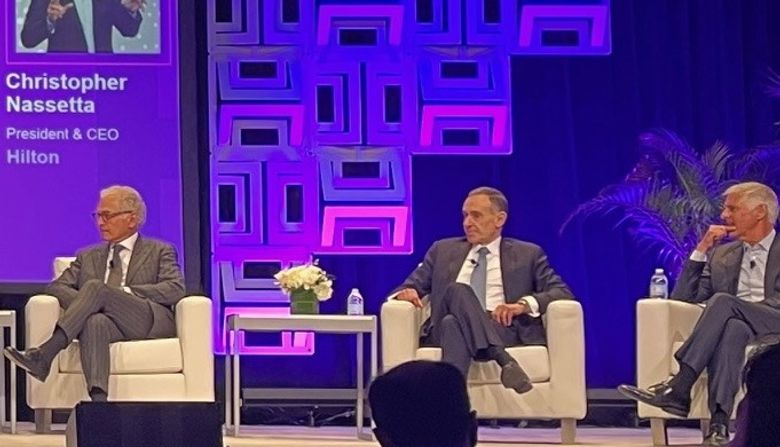
(left to right): Mark Hoplamazian, Hyatt; Elie Maalouf, IHG and Chris Nassetta, Hilton
Longer-term, the arrow continues to point up and to the
right with Hoplamazian explaining that there has been a shift in travel from being
considered a discretionary item to a basic human need. To a man on stage, the
message is the business remains resilient and the emergence of the middle class
and the ongoing transfer of wealth bodes well for the middle market up to
luxury.
As for bringing back international travelers to the U.S.,
Nassetta said there is not a lot of oxygen in Washington, D.C., to focus on the
travel and tourism deficit the U.S. faces. He suggested that by summer or fall,
when trade deals and the budget debate should be concluded, there will be a big
pivot to economic growth, including travel and tourism.
When discussing growth opportunities, India and the Middle
East were the consensus opportunity markets, and there was little discussion
about further development here in the U.S. It’s not that the brands on stage
don’t have pipelines, especially with their fledgling midscale and
extended-stay brands, but they were mostly bullish about those specific international
opportunities.
As for China, the panel believed real estate leverage
challenges will be worked out over time and growth opportunities remain,
highlighting the importance of maintaining and growing their presence in this
market.
Throughout the opening day of the conference, the tone
related to dealmaking and development remained reserved with macro uncertainty continuing
to cause investment pauses. However, there was consensus that once tariff and
budget challenges gain clarity, traction for growth and transactions should
increase.
Of course, there was the now-obligatory discussion about
how artificial intelligence is affecting business models with the panel saying the
role of AI is as a partner rather than a replacement, creating opportunities to
focus on enhancing human connections by increasing capacity for employees to
engage more with guests.