Gebhard Rainer, Sandals Resorts International’s CEO, gets granular on the planning and processes behind the company’s newest “first”, with takeaways for hoteliers across all segments.
The journey that brought Sandals Resorts’ newest brand debut in Saint Vincent and the Grenadines into the focal point of the international spotlight this year maps the new-model action steps for a “first” in any hotel segment.
In this exclusive custom content interview, Sandals’ CEO Gebhard Rainer tracks the benefits of leveling up the integration of process, planning and profit opportunities to maximize gain for pioneering projects.
Focus filters for site selection
Despite its physical beauty and sense of seclusion, Saint Vincent and the Grenadines represents a small blip on the world’s tourism radar. Even so, Rainer said it didn’t take long after he joined the company in 2018 to discover just how much of a priority it was for Sandals Resorts International to secure a presence in this southeastern Caribbean country.
“We should end up there. It’s paradise,” company founder Gordon “Butch” Stewart told Rainer shortly after his hiring. Although Stewart did not live to see it, the March 27, 2024, opening of the 301-room Sandals Saint Vincent and the Grenadines in Buccament Bay made his long-time wish a reality, where fate met strategy.
Tap into the power of partnerships
Any “first” is challenging, especially on an island, but this project had the added complexity of being the first luxury all-inclusive in the country.
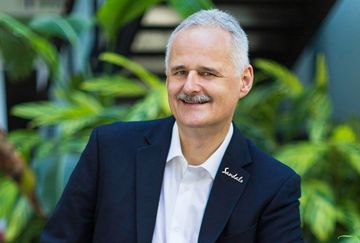
Gebhard Rainer, Sandals Resorts International
“Based on continuing demand from our loyal Sandals customers for new destinations and new experiences, we identified Saint Vincent as a fantastic new island for a Sandals resort,” he said. Financial assessments brought to light the capabilities of the property, including additional revenue opportunities from an increase in premium suite accommodations, including the brand’s first-ever two-story bungalows.
But that raised other issues about the site which would have kept the numbers from working for Sandals long term. According to Rainer, it did not have enough open land for the Sandals’ current and future vision for the development, including the additional villas.
“The government quickly and proactively consolidated land around the resort to come up with a total of about 50 acres, which we then purchased from the government and started developing in 2020,” he said. Some of the core structures were sound enough to refurbish, but the towers were demolished since upgrading them to current standards would have been more expensive than new construction.
Rainer praised government officials for coming forward with other solutions and incentives to get the development across the finish line. Part of a growing trend toward collaboration, he said the island’s leadership asked him to share best-practice pro-business policies from around the Caribbean.
“We collaborated with the government to develop hospitality incentives,” he said. “In discussions, we guided them towards what is typically being offered by other islands as well and what would be an attractive incentive package for investors to develop more high-end product.”
Rainer also told officials about conversations he’s had with airline partners about increasing airlift into the region. The island wasted no time in following up.
“There's a multitude of new airlift opportunities that are going to become reality by the end of the year when the high season starts in November and, of course, the airport needs to be able to cope with that,” he said. “The government is actively preparing for this.”

We collaborated with the government to develop hospitality incentives. In discussions, we guided them towards what is typically being offered by other islands as well and what would be an attractive incentive package for investors to develop more high-end product.”
Gebhard Rainer
Cost conscious innovation
Regardless of incentives, sourcing capital is still important but can be a tall task in the Caribbean, where supply chain issues and weather disruptions can make lenders nervous. Rainer said Sandals overcame such potential debt issues by pre-financing the project.
“We’re in the fortunate position that from philosophical and practical points of view, we can put our money where our mouth is,” he said. This approach puts lenders at ease, Rainer said. “So, for us, the capital stack is almost upside down.”
Relatedly, keeping costs down in a region where construction and insurance expenses can be notoriously high was a priority, Rainer said. Sandals solved this dilemma by sourcing materials for their experiential and authentic appeal. “We constantly challenge ourselves and look at ourselves to see where we can become more efficient, where we can create spaces that combine luxury with simplicity,” he said.
One example: repurposing the existing collection of beachfront restaurants and common spaces rather than razing them and starting from scratch. Rainer said there was a substantial inventory of equipment and decorative items left in those spaces that Sandals repurposed into its own design vision.
A shift in consumer behavior toward wanting more of an experiential getaway also aided in keeping costs under control, Rainer added. “New food-and-beverage concepts, for example, play a big role in that and these are concepts that often don't have to cost a lot of money,” he noted.
Rainer pointed to the resort's restaurant, Buccan, which features locally sourced cuisine, large-format dining and a chef who shares her grandmother’s recipes while also explaining how food is traditionally collected and prepared on the island. “It is part and parcel of what luxury is all about now. It also creates efficiencies for us because it doesn't always have to be more costly. It just needs to be much more of a unique experience,” he said.
The benefits of being an advocate for authenticity inform all of Sandals’ development strategies.
“We are fully aware of the responsibility we carry in terms of community involvement. We need to make sure small and medium size businesses are benefiting–that we truly are not only all-inclusive but that we are island-inclusive,” he added. “We take our customers out into the communities on the island and make arrangements so they can be part of that, and we support the local people, the culture and the environment rather than overlaying our culture on them. We allow the setting and people to write a one-of-kind definition of ‘5-star’.”
Shawn Turner is a writer and editor based in Stow, Ohio.
The views and opinions expressed in this content do not necessarily reflect the opinions of Hotel Investment Today or Northstar Travel Group and its affiliated companies.