On
the strength of sports and entertainment destinations, Las Vegas is poised for
a rebound in 2026.
LAS VEGAS — Driven by an uptick in group business and the
city’s continued evolution into a major sports and entertainment hub, the Las
Vegas hotel market is poised to rebound from a tough 2025 with robust gains
expected in 2026.
The Las Vegas Strip, which accounts for 70% of the metro
area's room inventory, has experienced lofty gains in occupancy and
profitability through the first three months of the year, driven by a stellar
March.
Year-to-date, the Strip has seen RevPAR increase 8.6%
through March, driven in large part by a 6.2% gain in ADR, according to CoStar
data. Occupancy, meanwhile, has increased 2.2% year-to-date to 83.1%.
In March, specifically, the market experienced double-digit
gains in RevPAR and ADR, increasing 24% and 19%, respectively. In addition,
occupancy in March exceeded 87%, a 4.2% spike from the same period in 2025.
Michelle Steffens, COO of Newton, Mass.-based Sonesta
International Hotels, which includes the Sonesta Simply Suites Las Vegas
Convention Center and Sonesta Select Las Vegas Summerlin, touted the
performance of the market this year.
“From our perspective at Sonesta, we have seen steady
year-over-year demand growth in Q1 in Las Vegas,” she said, later adding, “we
expect Las Vegas to continue delivering solid performance through the remainder
of the year.”
Michael Stathokostopoulos, research analyst, CoStar, parent
company of STR, further amplified the point.
“They are doing much better than we expected. Year-to-date,
we were projecting performance would be flat or slightly negative, and actually
they're up by [more than] 8%, which is a big number. That was a surprise,” he
noted.
Demand generators
Hotel executives point to the Sphere, a new world-class
entertainment venue, as well as the addition of professional sports franchises
such as the NHL’s Golden Knights and NFL’s Raiders in the past few years, and
the expected arrival of MLB’s Athletics in 2028. Furthermore, event-related
demand in 2026 is being further driven by a handful of large events, such as
the Las Vegas Grand Prix, WrestleMania 42 and the 2026 FIFA World Cup (though
the city isn’t hosting any games, it still thinks the World Cup will draw in
fans for the North American-hosted event).
“Demand in Las Vegas remains well-diversified and resilient.
Group and convention business continue to be primary drivers, complemented by
strong leisure demand tied to entertainment, sports and large-scale events,”
said Steffens.
Stathokostopoulos maintained that such demand generators
have been game changers for the market, effectively altering perceptions of Las
Vegas and the types of visitors it’s attracting.

Michael Stathokostopoulos
“The drivers of demand are changing. The city is doing all
the right things in order to transition to that new type of customer, which is
more driven by large-scale entertainment and events that are happening, as well
as sports,” he said.
With demand on the increase, Stathokostopoulos further
emphasized that the market has been able to drive rate, particularly within the
upscale and luxury hotels. As an example, he noted that rates in Las Vegas are
142% of 2019 levels, representing the biggest gains in the U.S. New York is the
third-highest market, with rates at 125% of 2019 levels.
“This reflects the fact that Las Vegas has been shifting a
little bit more upscale and everything has become a little bit more expensive,”
he said.
Stathokostopoulos noted that one of the few negatives for
the market has been a reduction in international tourism, particularly from
Canada, which has seen a 25% drop during the first three months of the year.
Meanwhile, Caesars Entertainment Inc. recently extended a
period of exclusive talks regarding a potential $18 billion takeover by Tilman
Fertitta, the owner of the Golden Nugget casino chain. Fertitta has been in
talks to purchase Caesars for roughly $32 a share. Icahn Enterprises, the firm
of investor Carl Icahn, has also reportedly been involved in discussions to
acquire the publicly traded company.
Hotel development, meanwhile, continues to move forward in
the market. Major projects include a conversion of Mirage into a 600-key
Hard Rock Hotel & Casino; the 531-key Dream Las Vegas; and Tropicana
redevelopment, which is expected be home to the New Athletics ballpark and a
Bally’s Resort.
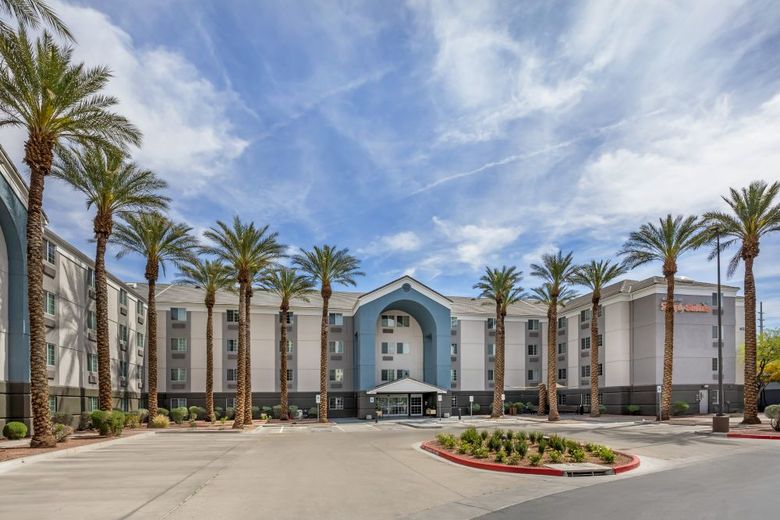
Sonesta Simply Suites Las Vegas Convention Center
“Developments that are moving forward tend to be
large-scale, experience-driven and backed by well-capitalized sponsors. There
is a clear emphasis on differentiation and integrated offerings that can drive
both rate and ancillary revenue streams,” noted Steffens.
Beyond the Strip, My Place Hotels has two locations in the
greater Las Vegas metro area. The midscale hotel brand’s location in North Las
Vegas opened in 2018, while the location in Henderson opened in February 2025.

Developments that are moving forward tend to be large-scale, experience-driven and backed by well-capitalized sponsors. There is a clear emphasis on differentiation and integrated offerings that can drive both rate and ancillary revenue streams.
Michelle Steffens
Ryan Rivett, president and CEO of Aberdeen, South
Dakota-based My Place Hotels, pointed out that demand growth in the market has
primarily come from “corporate, trade, logistics and medical segments.”
While the greater metro area hasn’t experienced quite the
same uptick as The Strip, Rivett noted he is largely optimistic for results in
2026.
“The fourth quarter peak season is too far away — and the
macro-travel environment is shifting too rapidly for a confident prediction —
but I would not be surprised to report the full year 2026 as a RevPAR growth
year,” he said.
He later added, “Overall, the submarkets of Las Vegas we
find ourselves in have given us confidence regardless of the condition or trend
in the greater metro area.”
Steffens, meanwhile, noted that the franchise company
remains quite bullish on the market’s prospects.
“Overall, we see continued steady growth with Las Vegas
maintaining its position as one of the most resilient and dynamic lodging
markets in the U.S.,” she concluded.