The
CEO for Ashford Hospitality Trust talks about moving on from COVID debt,
transitioning from selling to acquiring assets and the lessons he’s learned six
months into the job.
DALLAS — Stephen Zsigray is done
talking about COVID.
The CEO of Ashford Hospitality
Trust, who took the spot at the end of June, said the pandemic could have been
a “death blow” for the Dallas-based REIT, especially because of its financial
position in March 2020.
“Candidly, there are arguments
that we probably shouldn’t have survived COVID, given that our leverage was
higher than most of our peers going in,” he said. “It’s tough enough to survive
a 90% to 95% hit to revenue even if you have zero leverage. For us, that was
tough.”
Ashford Trust had to take on
corporate debt for the first time in its history, Zsigray said, and the REIT
has been in survival mode the past few years as it has been handing back keys
to lenders and selling off assets to pay off that debt.
But with the expectation that
the debt will be paid off early in the first quarter of this year, Zsigray said
he is looking forward to turning the page.
“The next chapter for me is this
breakpoint. We’re going to pay off that financing, and that’s the last I really
want to talk about COVID,” he said.
The first page of that new
chapter is all about growing EBITDA and the REIT’s value to investors.
“The market is telling us
they’ll pay 12 times (EBITDA), but that $250 million isn’t going to cut it. You
need more,” he said. “If we do that, you’ll see transformative impacts on the
common stock and the value and it positions the company then to start working
towards, ‘OK, let’s go be acquisitive.’”

We were extremely diligent about the assets that we sold. We took a lot of assets to market that we ended up not selling and saying at that price, that’s a keeper for us.
Stephen Zsigray
Two weeks ago, Ashford Trust
announced a “GRO AHT” plan to increase EBITDA and cut costs through layoffs,
pay cuts, streamlining labor costs and adding new revenue streams.
Hotel Investment Today talked to
Zsigray about the details of the plan and his desire for the company to return
to growing through acquisitions. He said most of the changes outlined in the
“GRO AHT” plan are happening at the property level.
“A lot of these things have
already been implemented by our property managers. I’m hopeful that by the
middle of 2025 or early 2025, we start seeing these results,” Zsigray said.
“The earlier we can get there, the sooner we can get to the real start of this
next chapter, which is we can go out there and buy portfolios of assets again.
We can be involved in some of these big deals that will be attractive.”
More details on GRO
AHT
Zsigray said the layoffs will
happen on the property level in redundant positions, as will the OT and PTO
changes (which involve Remington Hospitality, also owned by Ashford Inc., which
manages a number of the REIT’s properties) as ways to streamline labor costs.
He said the plan focuses on
maximizing room revenue by growing market share for its current portfolio.
“It’s really about gaining
market share,” Zsigray said. “If we look at where we are in terms of market
share relative to pre-COVID across the portfolio, our share of the markets that
we’re in is actually down relative to pre-COVID. The easiest place to get that
is to make up the ground.”
The plan also includes looking
for ancillary revenue streams, with F&B being the biggest (the REIT is
currently evaluating its menu pricing at all of its properties). The idea is to
maximize all of its streams (parking and gift shops, to name a few) and add new
streams as well (the REIT is exploring rolling out the concept of non-guests
using its amenities — something it has been using in the Dallas-Fort Worth
market — to all of its properties, for example).
Reshaping, adding to
portfolio
Zsigray said growing market
share also means enhancing the portfolio the REIT already owns.
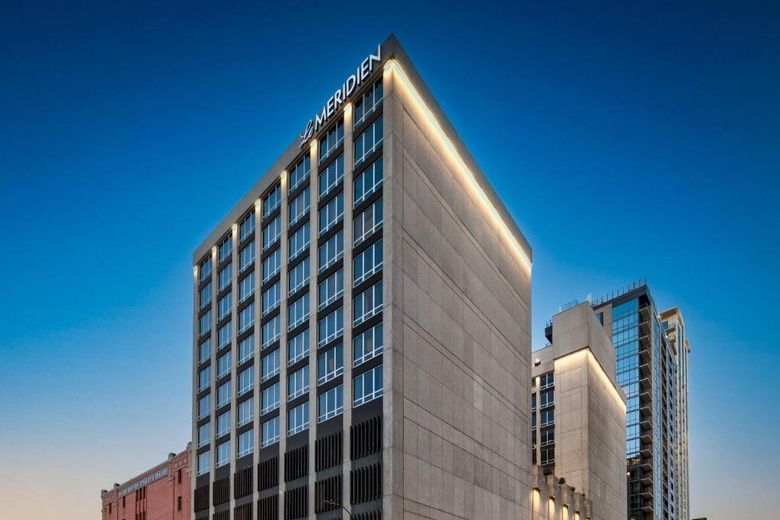
Le Méridien Fort Worth Downtown opened in August.
“We now have an opportunity to
grow market share that we didn’t have when we were already top of the market
when we were just trying to preserve our position… We will – we and probably
most other owners – be looking to over the coming years, through capital
expenditures, improving the quality of the existing product,” he said.
“It’s time for the industry to
find those dollars and reinvest in their portfolios or find new owners who are
interested in doing that… If you look at the property, you look at what it will
cost to renovate and if that renovation will yield a return. Is it going to
position me to earn a decent return on that investment? If the answer is no,
OK, then I should probably rotate out of that asset and go find one where I
feel like I can spend some dollars and get a return on the investment.”
Zsigray said as the REIT has
been selling off assets, it’s also been learning through bid-ask spreads which
properties already have outsized market value.
“If you’re not a forced seller – which in our case we weren’t forced to, we just wanted to monetize at fair
value in order to pay off some debt – then you don’t have to come down and meet
the bid and, in many cases, we didn’t,” he said. “We were extremely diligent
about the assets that we sold. We took a lot of assets to market that we ended
up not selling and saying at that price, that’s a keeper for us.”
Reshaping that portfolio also
means adding as well.
We were extremely diligent about the assets that we sold. We took a lot of assets to market that we ended up not selling and saying at that price, that’s a keeper for us.
Stephen Zsigray
“We want to get to a position
where the company can be acquisitive regularly,” he said. “We have a history
of making some really good deals, but it takes capital, and in order to be able
to raise capital, we need to execute this first.”
Lessons learned
When asked about the biggest
things he’s learned in his first six months as CEO, Zsigray said Ashford
Trust’s development of the Le Méridien Fort Worth Downtown in Texas taught him
a lot about all the development opportunities with incentive financing as a way
to grow a portfolio efficiently with investor capital.
“Institutions are sometimes not
nimble enough to play in that space effectively. For us, it’s a tremendous
opportunity if you can develop hotels,” he said. “Yes, it costs more, but
incentive financing is a great way to make up for that. So, as I look to the
first stages of how we build a portfolio, that will be a big piece of it. Can
we find opportunities where it may not even take a ton of capital from us? If
you’re successful in finding attractive conversions, or whatever it might be,
and you’re helping improve downtown areas while you’re at it, that’s exciting
for us.”
Ashford Trust has also been
active in the refinance market over the past few years, and Zsigray said he
sees improvement there as well, which means better times ahead for the M&A
market.
“I expect it will continue to
improve, and the transaction market lags the financing market… The improvement
in the financing market also makes it much less likely that you will have these
asset fire sales, where people have to sell a portfolio because at least now
they can refinance it.
“They may not like everything
about it, but it’s refinanceable. Whereas, I think six months ago, nine months
ago, a lot of those portfolios would have been in trouble.”