Hilton
CEO Chris Nassetta said the growth should come organically, adding that the
company wants to add more brands this year.
MCLEAN,
Virginia — When it comes to how Hilton will keep its net unit growth in the
6% to 7% range, something CEO Chris Nassetta said should be the case for the next
several years – he’s confident that growth will come organically. A significant
part of that confidence stems from the company’s ability to drive conversions.
“Our focus…
is on getting back to brand building the way we do it, where we see legitimate
white spaces that are opportunities to continue to build our network and add to
our growth,” Nassetta said during Hilton’s second quarter earnings call on
Wednesday. “So, the entire organizational focus is there.”
Nassetta
said he doesn’t think M&A for NUG growth will be a focus in the coming
years (although he did mention he’s almost bound to say “never say never”).
“We’re not
out bounty hunting to do acquisitions,” he said. “So, the way you should think
about the 6% to 7% (NUG growth) is that it does not imply that we’re going to go
out and buy anything. That implies our existing and new brands are going to
deliver that kind of growth.”

The team is working hard behind the scenes on several new brands in the lifestyle space, in addition to a couple of new concepts in the alternative accommodation space, a number of which are conversion-friendly.
Chris Nassetta
Hilton will
be adding more brands, Nassetta said, noting that the company is working on
expanding its offerings, likely by the end of the year.
“The team is
working hard behind the scenes on several new brands in the lifestyle space, in
addition to a couple of new concepts in the alternative accommodation space, a
number of which are conversion-friendly,” he said. “We have done the research
with our customers and have already received tremendous feedback from our
owners on these new brands.”
Overall,
conversions accounted for over one-third of Hilton's openings in the second quarter.
Nassetta said construction starts are also way up.
“Our starts
are going to be up 16% to 17% this year, and once they start, almost 99% to 100% of the
time they finish. We’ve seen those numbers, even in a very challenging
environment, tick up. So, that makes us feel really good,” he said. “We have the
biggest pipeline in our history. Half of it’s under construction and we
continue to see more and more going under construction.”
Hilton
approved 36,200 new rooms for development during the second quarter, bringing
its development pipeline to a record 510,600 rooms, a 4% increase
year-over-year, excluding the impact of acquisitions and strategic partner
hotels. The company added 26,100 rooms to its system, resulting in 22,600 net
additional rooms for the second quarter, which contributed to a net unit growth
of 7.5% over the past year.
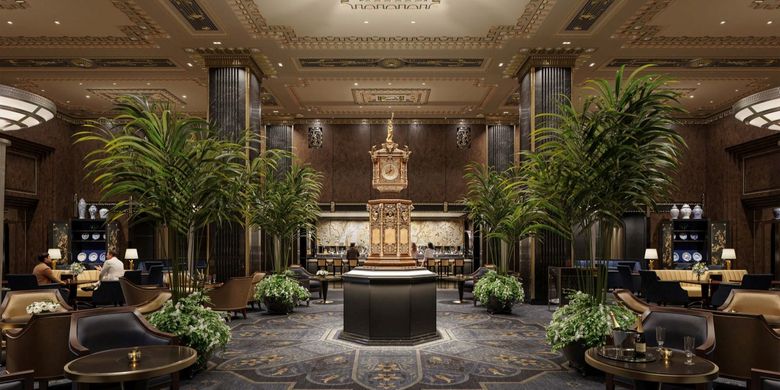
The Waldorf Astoria New York just reopened its doors after eight years of renovation.
On the
not-so-positive front, Hilton reported a systemwide RevPAR decline of 0.5%
year-over-year. Nassetta said the quarter turned out to be “noisier than
expected.” Hilton expects its third-quarter RevPAR to be flat to modestly down
again, but the ever-optimistic Nassetta said he’s positive about what can
happen later this year. He noted that after potential tariffs were announced,
people were rattled and “everything kind of froze up,” but he sees a time,
especially in the fourth quarter and in the coming years, where things are
thawing out.
“People are
getting out of the wait-and-see. Certainly, if you look at 2026 and 2027,
you’re seeing it,” Nassetta said. “There’s so much noise in the system right now,
politically and otherwise… but if you really lift up and look at what’s going
on in our largest market, the U.S., which is 75% of our business, you may hate or
like what’s going on, but it is pretty hard to deny that over the next several
years, we’re not going to end up in a condition where we’re going to have
incremental economic growth.”
For its
full-year projections, Hilton stated that 2025 systemwide RevPAR is projected
to be flat to +2% compared to 2024; full-year net income is projected to be
between $1.64 billion and $1.682 billion, and full-year adjusted EBITDA is
projected to be between $3.65 billion and $3.71 billion.
Other Q2
highlights
- Diluted EPS was $1.84 and
diluted EPS, adjusted for special items, was $2.20
- Net income was $442 million
- Adjusted EBITDA was $1.008
billion
- Systemwide comparable RevPAR
declined 0.5% YOY
- Hilton repurchased 3.2 million
shares of its common stock during Q2, bringing total capital return,
including dividends, to $791 million for the quarter and $1.881 billion
year to date
- Full year 2025 capital return is
projected to be approximately $3.3 billion
What the
analysts said
Analyst
Michael Bellisario of R.W. Baird said his company’s positive fundamental view
of Hilton is unchanged.
RevPAR is a touch softer, particularly domestically, but the trajectory of net unit growth is improving, which has been a key investor debate recently.
Michael Bellisario
“Fundamentally, the
near-term outlook is plus/minus unchanged looking through all the moving pieces
— RevPAR is a touch softer, particularly domestically, but the trajectory of
net unit growth is improving, which has been a key investor debate recently,” he said.
Analyst
Patrick Scholes of Truist Securities said Hilton’s Q2 earnings were well ahead
of consensus, but there are longer-term concerns about NUG growth.
“A hot topic for investors today: How does HLT get to 6% to 7%
organic NUG growth for 2026 (and perhaps for 2027+) despite the “very limited
(overall) industry supply growth” that management called out on the earnings
call? We see it primarily driven by ‘self-help’ initiatives on filling in what
‘white space’ remains,” he said.