President and CEO Chris Nassetta said he sees a path to a positive second half of 2025 despite the current noise and economic uncertainty. He also sees new brands in the future.
McLEAN, Virginia – Hilton President and CEO
Chris Nassetta freely admits he’s an optimist. So, it’s not surprising that he
takes a positive spin on the current environment of the hotel industry.
“I would say, based on lots of
discussions and years of experience, that at the moment, the risk in the
marketplace is weighted too heavily to the downside,” Nassetta said during the company’s first-quarter
earnings call. “If I look at what’s going on in our business, certainly, we’ve
seen a modest step back in demand patterns. But, at the moment, those seem to
be relatively stable.”
Nassetta said he’s been through
several recessions and black swan events in his 40 years in the industry. He
lives in the Washington, D.C. area and talks to a lot of people on Capital Hill
and in the current administration to get a gauge of what’s going
on. He said he’s an optimist in a room that is skewing negative right now.

My own view is… the market is asymmetrically taking the risk of downside. I think it’s a much more equally weighted risk. I am an optimist by nature… The intermediate to longer-term risk is probably more weighted on the upside.
Chris Nassetta
“My own view is… the market is
asymmetrically taking the risk of downside,” he said. “I think it’s a much more
equally weighted risk. I am an optimist by nature… The intermediate to
longer-term risk is probably more weighted on the upside.”
Whether it’s market uncertainty,
tariffs and trade deals, lowering regulations or extending tax cuts, Nassetta
said you can criticize the process, but he thinks “real progress is being
made.”
“It’s choppy and there’s a lot
of noise, but the legislative process is grinding through… There’s a reasonable
probability that [it all] gets done, which is going to create maybe
not perfect stability, but a lot more stability, a lot more certainty of what
the deals look like and what the future is," he said. "It’s not crazy to think that all
that starts to come together this summer, and as a result, when you get to the
second half of the year, you could be in a very different place.”
All eyes were on Hilton on
Tuesday as it was the first major U.S. hotel company to report this earnings season.
There has been speculation about whether the company will pull its guidance for
the rest of the year, as some airline companies have cited an uncertain
environment. The company revised its guidance for the rest of 2025, trimming
full-year room revenue growth. RevPAR was lowered to flat to +2% (versus +2% to
+3%) previously, while adjusted EBITDA was cut by 1.1%. Hilton said full-year
net income will be $1.71-$1.75 billion, compared to $1.83-$1.86 billion.
On the positive end, Hilton beat
Street expectations and said net unit growth for the year is projected to be
between 6-7%. For the second quarter, Hilton forecasts system-wide comparable
RevPAR to be roughly flat compared to the second quarter of 2024. Adjusted
EBITDA is forecasted to be $940-$960 million.
Nassetta said Hilton knew that
many companies had not issued guidance and that his view was very simple.
“We know more about our business
than anybody else,” he said. “I think we do, and I feel like we have an
obligation, even in uncertain times, to give you a sense of the various
outcomes that we think based on assumptions… We’ve tried to be as scientific as
possible. I feel very good about how we thought that through.”
‘Wait-and-see mode’
Nassetta said broader macro
uncertainty intensified in March, and RevPAR growth was led by the group business, which
increased more than 6% year-over-year, supported by growth in urban markets.
Transient RevPAR increased by 2%, which was led by a solid performance from
small- and medium-sized businesses, which Nassetta referred to as “resilient
customers” and make up roughly 85% of Hilton’s business.
We believe travelers are largely in a wait-and-see mode as the rapidly changing macro environment continues to unfold.
Chris Nassetta
“We believe travelers are
largely in a wait-and-see mode as the rapidly changing macro environment
continues to unfold,” he said.
Hilton doesn’t give guidance
lightly, Nassetta added. “It’s super granular analysis,
and when we give guidance, it’s because we feel really good about it,” he said.
“You can see in the first quarter we have a huge amount of momentum on
conversions. The things under new under development and new construction are in
process that they’re going to deliver this year. They’re largely getting close
to being done… If you look at the quarter, the data suggests everything looks
great. Signings are up, starts are up, deliveries are up on a year-over-year
basis.”
Nassetta also said the guidance
doesn’t come without risk, especially if his optimistic interpretation is
wrong. “So far, we haven’t seen any
real impact… If this persists, if I’m wrong, then the uncertainty of this level
persists for a longer time… It’s just logical and rational to think it would
have some impact...
“However, if I’m right, and
things do start in the second half of the year to settle down, I don’t think
you have to believe that this has a lot of impact,” he said.
Nassetta also said, when asked
about growth and potential M&A, that Hilton is still focused on organic
growth but will be launching three new brands in the future: a couple in the
lifestyle space under Tapestry, a hard brand in between Motto and Canopy and
one in the furnished apartment space.
“My expectation is you will see
us do something there,” he said. “We look at everything… but we have made great
progress over 20 years of doing it the old-fashioned way. We’ve built a skill
set and a team that is good at this… We have 24 brands, and my guess is in
the next year or two, we’re going to have 27 that we think will continue to
fill niches… That’s the likely path.”
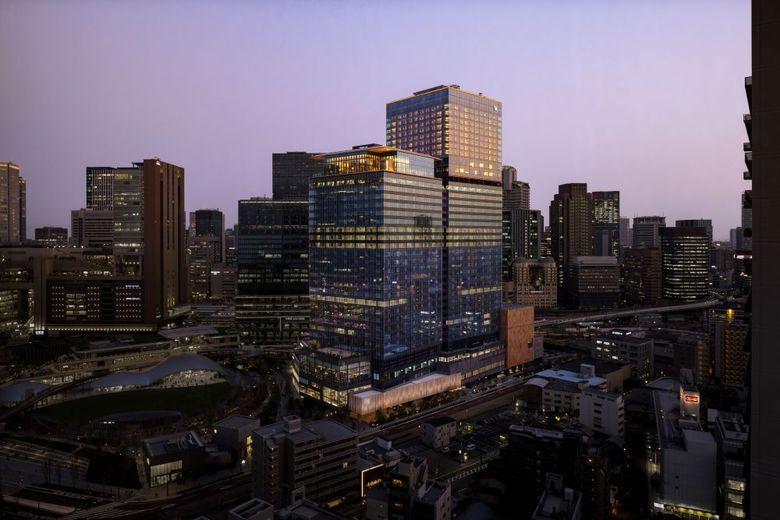
The Waldorf Astoria hotel in Osaka, Japan was one of Hilton's marquee openings in April.
What the analysts
said
Analyst Michael Bellisario of
R.W. Baird said he expects Hilton to eventually acknowledge “incremental U.S.
development headwinds/uncertainties” and point toward the lower end of guidance
for NUG growth. He also said the RevPAR guidance cut isn’t surprising.
“We believe the 150 [basis
points] reduction at the midpoint is plus/minus in line with recent buy-side
expectations,” he said.
Analyst C. Patrick Scholes with Truist Securities said he
credits Hilton with providing full-year guidance, which could set expectations
for the big hotel companies.
“We are not surprised to see
guidance light for 2Q and lowered for [full year]. We commend [Hilton] for
still providing full-year guidance and we could expect other hotel companies to
follow suit. For now, we believe the lower end of the [full-year] guidance
range is the more likely outcome than the higher end of guidance. Implied
[second half 2025] RevPAR guide is -1% to +2.75%, and we struggle to assume a 2H25
acceleration to hit the high-end of the revised RevPAR guide.”
Other first-quarter
highlights
- Diluted EPS was $1.23; diluted
EPS, adjusted for special items, was $1.72; net income was $300 million; and
adjusted EBITDA was $795 million.
- Hilton opened 186 hotels,
totaling 20,100 rooms, resulting in 14,000 net room additions. Hilton expanded
its luxury and lifestyle portfolios, which accounted for approximately 30% of
all hotel openings in the first quarter. Marquee openings in April included
Waldorf Astoria hotels in Osaka, Japan, and Punta Cacique, Costa Rica.
- The company added 32,600 rooms to
the development pipeline during the first quarter, as of March 31, its
development pipeline totaled 3,600 hotels representing 503,400 rooms (+7% YOY)
throughout 123 countries and territories, including 27 countries and territories
where it had no existing hotels.
-
Additionally,
nearly half of the rooms in the development pipeline were under construction,
and more than half were located outside of the U.S.