Reside
Founder and CEO Lee Curtis explains how the deal came together and how he plans
to expand into the branded residence business.
SEATTLE – Wyndham Hotels & Resorts has been a little
light in the upper middle extended-stay tier, especially as its loyalty club
members look to push up the chain scale. They may have found an answer in Seattle-based
serviced-apartment company, Reside, which has been in business for 30 years, mostly
on the furnished corporate housing side with average stays around 60 days. Now, Reside
has the Wyndham Residence brand behind it to push deeper into the B2C residence-style
vertical for more transient business with an average stay of about four days.
The 10-year development deal that was announced in late
October has Reside paying Wyndham franchise fees, including room royalties, in return
for branding and Wyndham services.
Reside already has been managing two properties under the Trademark Collection by Wyndham (The Beekman
Tower and Broadway Plaza in New York City). With the five properties announced so far under Reside,
a Wyndham Residence and corporate housing managed in Puget Sound - this
inventory expands upwards to over 2,500 units depending on the time of the
year.
Reside also has a separate tech platform, a
corporate housing marketplace called 3Sixty,
which taps into more than 1 million accommodation options across 60 countries
For Reside Founder and CEO Lee Curtis, this is a new
opportunity to primarily convert multi-family properties that are having
trouble filling up with leases and as well as competitors who are struggling
without the weight of a major brand like Wyndham behind it. Reside manages the
properties with a mix of fully furnished studio, one- and two-bedroom units.
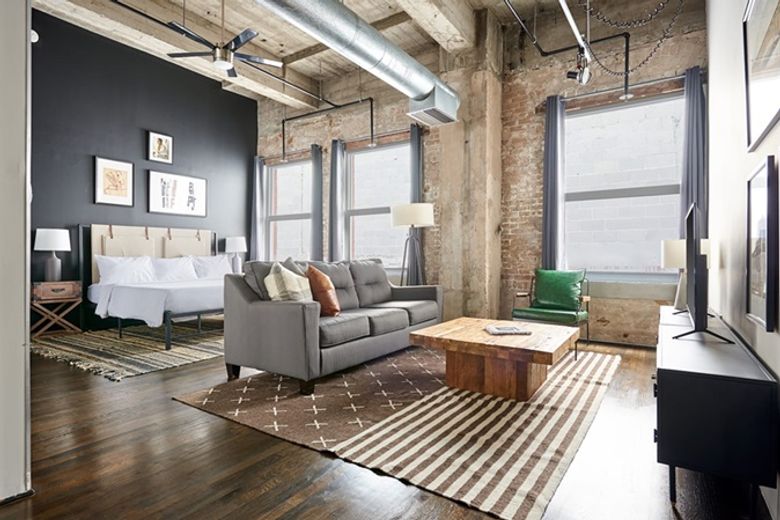
Reside Houston Downtown room and common space
Curtis told Hotel Investment Today his phone is ringing with
some 30 deals already in the underwriting process as it targets the top 50 MSAs
and their surrounding areas. He is shooting for 20 to 30 openings next year and
is seeing a much wider range of developers coming to the table than expected.
He would like to reach 50 inside 24 months and “a couple of hundred” within five
years.
That said, Curtis added that they will not “force feed”
deals. “They have to represent what we’re trying to build and represent Wyndham
correctly.”
Five deals have been completed and the Reside Seattle
Downtown and Reside Houston Downtown are already open with Wyndham Residence
branding. Two deals in Washington, D.C., and one in New Orleans are in the pipeline
with Curtis saying a deal in Florida will be announced soon.
“What they’re giving us is quantifiable and, I believe,
sustainable demand,” Curtis said. “They’re getting paid royalties and we’re
getting access to a system we normally wouldn’t have access to… The short-term
rental space and some of the players have struggled from the same inevitable
headwinds of only being able to generate so much demand over an OTA channel. We
get to the same space, and then then we go way past it with Wyndham.”
Curtis said RevPAR is in the $160-plus range up to $200,
predicting rates for studios in a market like Washington, D.C., in the $160
range up to $300 for a two-bedroom unit. Occupancy, he said, should stabilize
around 75%.
Merry band of developers
To source deals, Curtis said Reside has a “merry band” of
traditional brokers and other groups that specialize in off-market deals. Since
the Wyndham announcement, he and his team are also on the road meeting with
national brokers to educate them about the new opportunity. He added that
Wyndham’s development team is now aware of Reside and is already providing some
leads, as well.

We come in, convert the building to fully furnished and run it through the Wyndham channels. It really changes the operating demand dynamics of that property and dramatically increase the NOI – up nearly 100% from unfurnished.
Lee Curtis
“We’re not necessarily advocating or pushing toward ground-up
development like most hotel chains,” Curtis explained. “This is really a
conversion product and because of that, it opens up many different
avenues to developers in some overbuilt markets in Texas, or in Seattle, where there
are too many apartments coming online without enough business traffic or
leases. They’re not meeting their initial goals. So, we could be a really good
fit for an owner that needs a better answer. We come in, convert the building
to fully furnished and run it through the Wyndham channels. It really changes
the operating demand dynamics of that property and dramatically increase the NOI
– up nearly 100% from unfurnished.”
While converting existing or newly completed apartment buildings
is the primary source of development, Curtis said he is starting to see some
conversions of other types of commercial property.
“On my last trip to D.C., I was seeing a lot of that happening,”
he said. “It’s a great fit for us because the footprint’s the right size, the
locations are good and there’s an appetite for something that isn’t commercial.
I think New York will eventually get there, too.”
Curtis has also seen some interest from groups with product
in leisure areas like the Smoky Mountains, where there is a built-in demand
component. “I’m working with a group right now that wants to develop a handful
of them outside of Nashville where there are theme parks,” he said.
As for their own investment, Curtis said Reside is owned by
a Canadian private equity firm called Westbridge Capital, who is watching this
deal closely. “I wouldn’t be surprised over the course of this agreement that
we start looking at acquiring certain assets that just make sense for us,” he added.
He
concluded that Reside deals will make sense because of the affiliation with
Wyndham. “It will absolutely drive exceptional NOI to the bottom line, period;
it’ll increase the value of the asset, period,” he said. “If that lines up with
your own thesis as an owner or property investor, then you should be talking to
us. And I say that only because that isn’t everyone's goal. I know it seems
like it is, but in multifamily there are many groups that are more
about the cap rate and the idea of almost perpetual annuity-type rental revenue
over exceptional profits and growth. I’ve learned a lot the last couple years.
I know we all wanted to make more money, but maybe not everyone does.”