On the occasion of its 500th extended-stay
announcement, Choice’s segment lead Matt McElhare goes deep on strategy,
pipeline, efficiencies and more.
NORTH BETHESDA, Maryland – On the occasion of Choice Hotels
International celebrating its milestone 500th extended-stay property opening,
an Everhome Suites in Glendale, Arizona, Hotel Investment Today spoke to Matt
McElhare, Choice’s vice president and segment lead for extended-stay brands, to
get underneath the numbers to see how they are driving growth and meeting
developer expectations in an increasingly crowded segment.
Choice said at the end of 2Q24, it had nearly 400 hotels in
the pipeline across four extended-stay brands: Everhome Suites, WoodSpring
Suites, Suburban Studios, and MainStay Suites. McElhare said about a quarter of
those hotels are conversions.
Choice has six Everhome Suites open across the country and more
than 65 in its pipeline, including more than 20 under construction, with more
than 15 expected to open within the next 12 months. WoodSpring Suites, its
largest extended-stay brand with a lean staffing model and optimized
operational efficiency, is forecast to open 25 properties by year-end.
Choice added that of the 161 Woodspring properties in the
performance sample in 2023, 93 hotels or 58% met or exceeded 55.5% GOP.
The company also opened 13 MainStay Suites and Suburban
Studios between January 1 and September 2024 in the key markets
of Las Vegas; Moreno Valley,
California; Orlando and Tampa, Florida.
To create greater efficiencies, reduce development costs, increase
speed to market, and give it a competitive edge, Choice has recently rolled out
a model designed for rapid conversions in as little as three to four months for
its MainStay Suites and Suburban Studios brands via proprietary Kitchen and
Lobby in a Box tools and efficient new-build prototypes with Everhome Suites
and WoodSpring Suites.
It is also using a proprietary system called Choice Maps, a
platform that analyzes proprietary data through AI and data science tools to
help secure the best sites in the markets with the highest demand.
Hotels Investment Today talked to McElhare about these
concepts and more in a one-on-one interview earlier this week.
Hotel Investment Today (HIT): You tout a pipeline of 400
extended-stay hotels. How many of those are fully financed deals?
Matt McElhare: We have over 50 hotels under construction… And as is normal and expected, of that 400 there are some that are in a waiting period for one reason or another.
They were signed in a different cost environment, both cost of capital, cost to
build.
So, there’s certainly some deals that maybe don’t work anymore in the current
conditions, especially on the economy side.
But one of the things that we have that that helps solve for
that is we have conversion and new construction options. So, of that pipeline,
you also have a number of conversion properties, and the developers have access
to capital. It’s a lower hurdle for them. And that’s a huge opportunity for us
as well, and it’s allowed us to continue to grow at a 10%-plus CAGR, despite
the fact that without a doubt new construction is more challenging.
We’re continuing to do things to help our developers get
deals either financed or help overcome hurdles relative to the underwriting. We
support deals through key money or discounting, particularly with Everhome Suites
as we’re trying to get this proof of concept in place. But even with Woodspring,
particularly with developers that have built multiple Woodsprings with us, we
will help them continue to grow because we want to continue to grow that 500 number
and get that to 600, 700 and beyond because it's just the early days of the
growth story for extended-stay.
HIT: Can you give us some specifics about how you are
helping with financing?
McElhare: I will tell you are we are investing in our own Everhomes
via joint venture structures or self-development. We are using our balance
sheet to build Everhome hotels. We have more than 10 right now open and or
under construction that are part of either a JV deal or self- development.
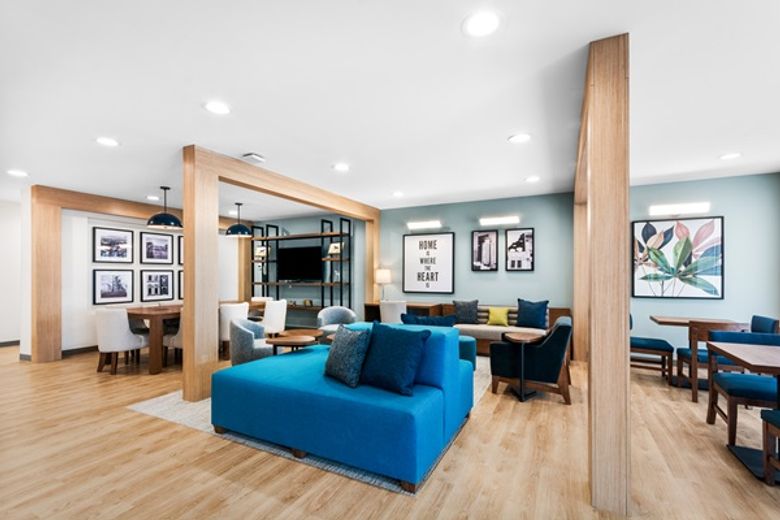
Everhome Suites lobby in Glendale, Arizona
Outside of that, for every deal we can offer incentives on
the new construction side. That’s dictated by our net present value calculation
and what we call deal value… For our key developers focused on this segment, we’re
doing whatever we can to help them grow and to continue to get deals done in a
tough environment.
HIT: How many are you developing on your own with Everhome
Suites?
McElhare: There’s not a set number of self-development deals
versus JV deals. What we’re really trying to do is create that proof of concept
for Everhome… We want to build them in different markets with different demand
fundamentals to really solidify that proof.
HIT: Talk about the momentum created by WoodSpring Suites.
McElhare: The success of WoodSpring through COVID is what created
the sense of urgency for a lot of our competitors to launch brands. WoodSpring
ran 50% of GOP in 2020, which was just unheard of given the environment…
WoodSpring is sort of what everyone’s trying to recreate, and that that is a
brand that we’re about to have a record opening year this year, which beat our
record opening year the year before.
It's much more challenging to get a new brand financed in a
difficult environment. But with WoodSpring, you have the proven prototype. You'
have a proven performance set, including bottom line performance, and then you
have the proven exit – the Blackstone transaction – that gives that an
institutional kind of check, check, check. So, those, hotels are getting
financed.
HIT: How are you doing on construction budgets?
McElhare: The challenge was getting enough subcontractor
bids and interest in the projects to get a good price... We saw that elongate
over the last few years, from sub-12 [months] with WoodSpring to 12-13 and even
14 [months] in some cases. But this year, and at least with our Everhomes, they’ve
mostly performed close to budget. There haven’t been these challenges that we
were facing in 2021 and 2022. A lot of that has started to alleviate, which is
allowing us to go a little quicker.
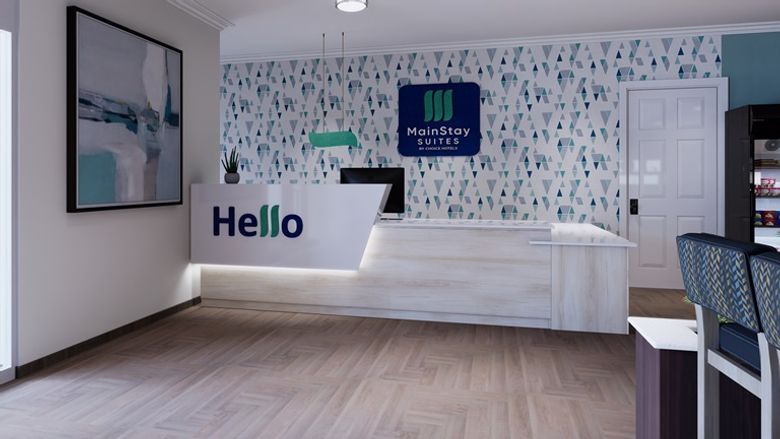
The Lobby in a Box concept for Choice Hotels; MainStay Suites
HIT: What are you doing to reduce construction costs and
create some operational efficiencies?
McElhare: We’re shrinking back-of-house. We’re looking at
the room orientation to see if you need to take 10% out of the room sizes…
The best thing we can do is create tight feedback loops with
the contractors that build the hotels, the developers that are working on these
deals, and really make sure that we’re reflecting market realities… We have
really good pricing on a cost per key basis, and we’re using that to make sure
that we’re making changes where we can – whether it’s to our fee structure or
to the hard costs – to make sure that the numbers work really well.
We need to make sure that it’s just as attractive for
developers as it is for guests. That’s what we’re going to continue to optimize
based on the feedback. But it’s a lean box.
We are doing things like creating one wet wall [in
guestrooms] versus multiple... We’ve already value engineered public spaces to
where it’s not a large space. We don’t serve breakfast [at Everhome Suites], so
you don’t need that staging area.
HIT: Can you explain how Choice Maps works?
McElhare: We give our developers an opportunity to find the
best sites in the best markets for extended-stay and get in first. We’ve
leveraged a tool that we’ve built that’s a proprietary algorithm looking at
population data, economic data, and pulling in data from the performance of our
500 hotels. We translate that into a mechanism to score any site in the United
States from one to 10 based on its attractiveness for either economy extended-stay
or for midscale extended-stay…
Anyone can pull the economic data in, but you can’t train it
against 500 lower-price extended-stay hotels, the way we can. So, that gives us
a bit of a competitive advantage.
HIT: What can you tell us about the Kitchen and Lobby in a
Box concepts?
McElhare: It represents one of the biggest opportunities and
I don't think it’s been talked about enough. In fact, I even hesitate a little to give too many details here.

We’ve even seen some lenders start to treat extended-stay as its own asset class versus lumping it together with a lot of the other hospitality investments, which is encouraging and overdue, in my opinion.
Matt McElhare
There are a lot of older, traditional hotels that are
sitting in good extended-stay markets with really good sites, big rooms, high
key counts. They have all the conditions that could support a nice extended-stay
hotel, and really high performance.
So, we’ve given them a design package that allows them to
quickly and efficiently transform into an extended-stay hotel. It’s early days,
but we have 20 of these open and we have another 10 that are being actively
transformed.
Most developers use the kitchens first.
For the lobby, many of them used to serve breakfast and the
room looks like it. The design package allows them to go a la carte to
transform that lobby space to something that’s a little bit more suitable for
extended-stay.
We have a partner that’s offering franchisees three years
interest free financing on the FF&E… We see this being a primary growth
driver for our extended-stay business over a number of years.
HIT: Any closing comments about your extended-stay strategy?
McElhare: We’ve gotten the Everhome revenue producing square
footage almost to where we were with WoodSpring – the efficiency of the box,
that’s what allows you to really drive that strong cash-on-cash returns because
the cost of build is low.
We’ve even seen some lenders start to treat extended-stay as
its own asset class versus lumping it together with a lot of the other
hospitality investments, which is encouraging and overdue, in my opinion.