From biodiversity and climate action to positive community
impact and overall sustainable design, four hotels highlighted for their
excellence.
SINGAPORE – The organizers of the 35th annual Hotel
Investment Conference Asia Pacific (HICAP) have announced the winners for the
HICAP 2025 Sustainable Hotel Awards. HICAP is being held October 22-24 at the
Fairmont Singapore & Swissotel The Stamford.
The annual HICAP Sustainable Hotel Awards are designed to recognize hotels in
the Asia Pacific region creating innovative new methods, strategies, and
technologies to face today’s sustainable development challenge, while providing
tangible examples of sustainable best practices that can be replicated and
adapted across the region.
Biodiversity Action & Education: Khaolak Merlin Resort, Phang Nga, Thailand
Khaolak Merlin Resort preserves almost half of its 30-rai
property as rainforest, maintaining over 250 native trees that shelter more
than 200 wildlife species, including hornbills, kingfishers, and endangered
slow lorises. A resident biologist leads birdwatching tours, night walks, and
activities at the Nature Lab, turning the resort into an outdoor classroom for
biodiversity.
Sustainability is embedded in operations. A closed-loop
wastewater system supports ponds and canals that nurture fish, reptiles, and
amphibians while irrigating gardens. Food waste is reused through donation,
composting, and microbial fermentation, enriching soil for the resort’s native
tree nursery. Partnerships with Love Wildlife Foundation and Big Trees Project
ensure robust biodiversity surveys and habitat management, with camera traps
confirming a growing slow loris population. Through conservation, guest
education, and circular consumption models, the resort has become a sanctuary
for nature and a model of biodiversity-focused hospitality.
Climate Action: Como Metropolitan Singapore
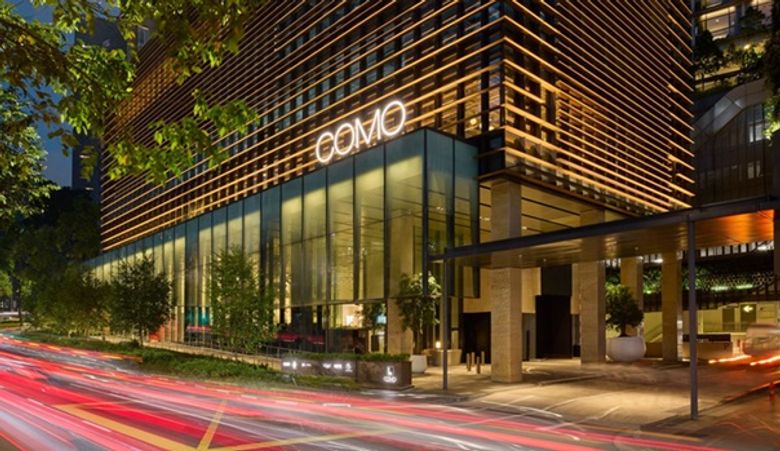
Among key initiative at the Como Metropolitan Singapore is a solar thermal system.
Como Metropolitan Singapore is redefining urban
sustainability through measurable climate action. With 156 rooms in Orchard
Road, the hotel holds EarthCheck Silver certification. In 2024, it achieved
35kg CO2e/m2 — an 69% reduction compared to CHSB* Singapore 5-star average of
113 CO₂e/m2. Energy intensity was cut to 85 kWh/m²/year and water use reduced
to 317 litres per room night, far outperforming national averages.
Key initiatives include solar thermal systems, AI-driven
HVAC optimization, motion-sensor lighting, and smart in-room controls. Waste
efforts diverted nearly 20 tonnes from landfill to waste-to-energy
incineration, while recycling avoided over 41.7 tonnes of CO₂e, bringing the
hotel’s total savings to 55.7 tonnes CO₂e in 2024.
Awareness is embedded into operations: staff-run “No
Single-Use Plastic Days,” refillable amenities, biodegradable dining ware, and
circular sourcing partnerships. COMO Metropolitan Singapore proves that
sustainability and luxury can coexist, setting a benchmark (*CHSB – Cornell
Hotel Sustainability Benchmarking) for climate action in Asia’s hospitality
sector.
Positive Community Impact: Six Senses Con Dao, Vietnam
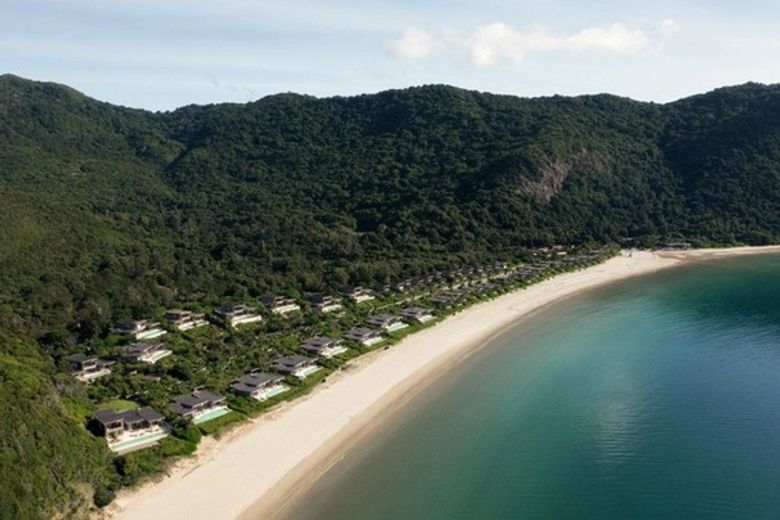
At Six Senses Con Dao, a ring-fenced Sustainability Fund channels 0.5% of monthly revenue into local projects.
At Six Senses Con Dao, a ring-fenced Sustainability Fund
channels 0.5% of monthly revenue, 50% of water sales, 100% of mascot toy sales,
and guest donations into projects that deliver measurable, local benefit. Water
for All has installed 11 filtration systems, giving 3,194 residents safe
drinking water. In 2025, a hotel-led Menstrual Health & Sustainability
Initiative provided 250 reusable kits and training to 470 women and girls.
With the Youth Union and WWF Vietnam, the 2R Station Project
has diverted 441 kg of recyclables and built community circularity, reinforced
by rotating clean-ups and new public bins.
Capability and inclusion are central: free English classes
have served 150+ local youths since 2017; Earth Lab workshops engage 500+
participants annually with hands-on sustainability skills; and an Animal Care
Project supports veterinary outreach and humane-care education. Co-created
cultural experiences with artisans and fishers sustain livelihoods and place
identity, with progress transparently reported throughout the year.
Sustainable Design: Uga Chena Huts, Sri Lanka
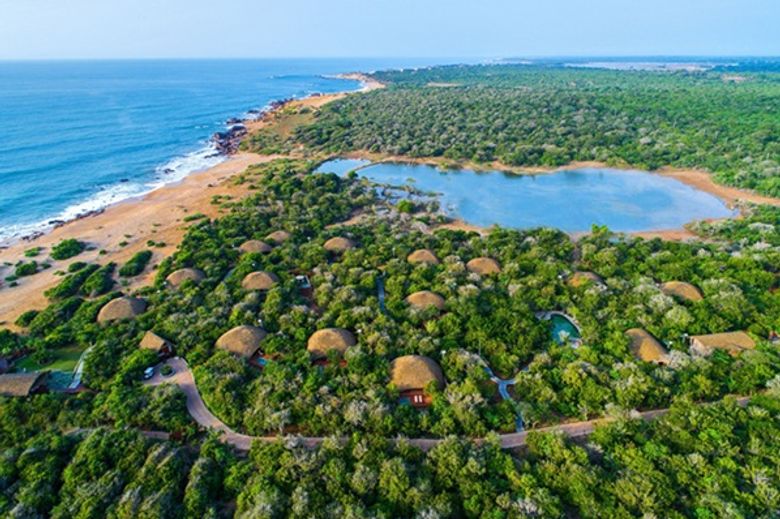
Villas at Uga Chena Huts, Sri Lanka, use biodegradable durra board, mud plaster, and illuk grass roofing.
Uga Chena Huts, located on Sri Lanka’s southeastern coast
beside Yala National Park, offers 18 villas that combine ecological sensitivity
with cultural authenticity. Modeled after traditional chena farmer huts, the
villas use biodegradable durra board, mud plaster, and illuk grass roofing,
while interiors highlight local craftsmanship and heritage.
The resort was designed to minimize ecological disruption:
semi-permanent structures preserve natural geography, strict tree-cutting
limits were enforced, and native species were replanted. With no perimeter
fencing, wildlife moves freely, allowing the property to serve as a natural
corridor for elephants, leopards, and other species.
Sustainability measures include rooftop solar panels, solar
thermal water heating, inverter AC, desalination for potable water, and 100%
wastewater reuse for irrigation. Benchmarking shows energy savings of 10–15%
and water savings of 12–18% compared to peer hotels. With LEED Gold and
Travelife Gold certification, Uga Chena Huts sets a benchmark in sustainable
design, blending luxury hospitality with ecological stewardship.