Measures and techniques utilized at the voco Zeal Exeter
Science Park in England to achieve net-zero carbon construction.
EXETER, England – IHG Hotels & Resorts has opened its
first branded zero carbon hotel in partnership with Zeal Hotels and Valor
Hospitality. The voco Zeal Exeter Science Park has been designed to operate
entirely on renewable and solar energy.
The 142-room hotel has earned a BREAM Outstanding rating as
the first building in the U.K. that has utilized vertical photovoltaic panels
as a rainscreen cladding system. It also follows the Passivhaus standard for
ultra-low energy buildings and uses adiabatic cooling and heat reversible heat
pumps to reduce energy usage.
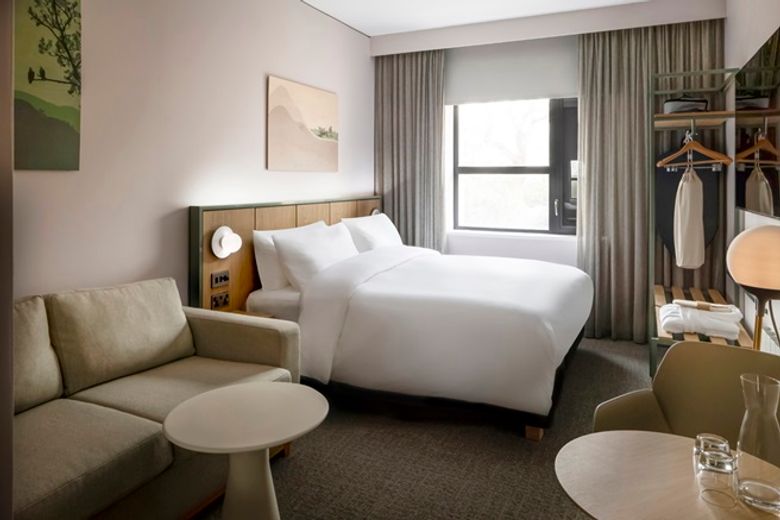
The voco Zeal Exeter Science Park bedroom
Voco Zeal Exeter Science Park was constructed using
materials chosen for their sustainable characteristics and assembled to achieve
best-in-class results. For example, they have used Ecocrete during
construction, a low carbon concrete with up to 85% less CO2 than CEM1 (100%
cement).
The hotel has been designed to reach net-zero operational
and embodied carbon.
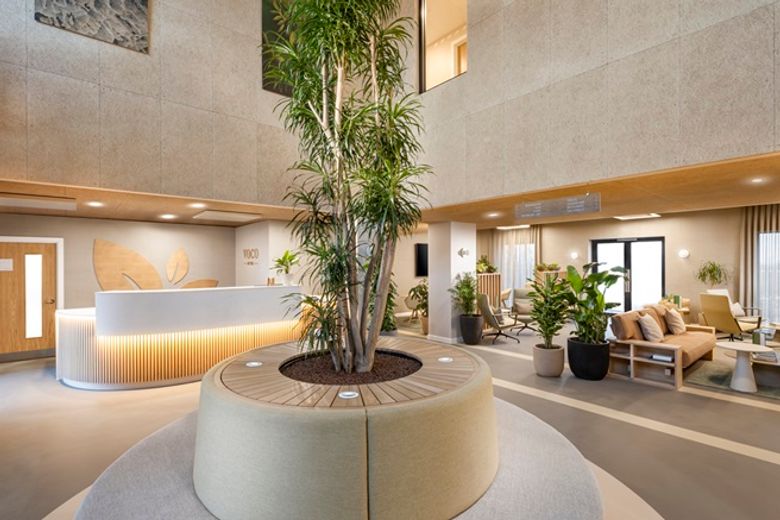
The voco Zeal Exeter Science Park lobby
Various measures and techniques have been utilized to
achieve net-zero carbon construction, including:
- The building has been designed to minimize
operational energy use and should achieve an EUI (Energy Use Intensity) of less
than 60kWh/m2, one of the lowest known in the U.K. This has been done by
following the Passivhaus building standard to ensure that the building requires
less energy for heating and cooling as well as using heat recovery, adiabatic
cooling for guestrooms and reversible heat pumps for balanced load sharing.
- Refrigerant emissions have also been minimized
by using CO2 heat pumps, with a Global Warming Potential (GWP) of 1, for
domestic hot water - a significant reduction in environmental impact compared
to conventional refrigerants.
- It is designed to operate entirely on renewable
energy and maximize on site renewable electricity generation through vertical
photovoltaic panels.
The embodied carbon used in the construction of the hotel
was reduced through sustainable material choices, including the use of 60%
Ground Granulated Blast-furnace Slag (GGBS) in the concrete mix for the
building frame (GGBS is a by-product from the blast-furnaces used to make
iron). The remaining embodied carbon will be offset.