An
on-going battle for staff in Maldives’ luxury segment is getting hotter and
Pontiac Land's focus on staff 'living' puts it in pole position.
MALDIVES
– When it comes to investing in human capital in the Maldives, few would
dispute that Pontiac Land Group is the gold standard. The Singapore-based
developer owns Fari Islands, a group of four islands in North Male Atoll. It
could turn them into four luxury resorts. Instead, it dedicated a whole island
for staff ‘living’ – a spacious, enriching environment for next-gen employees,
with proper town planning, full recreational facilities and amenities, career
development opportunities, and an active social calendar to foster community
spirit.
In
the Maldives, that's a disrupter. In fact, staff quarters are typically located
in the center of the resort to maximize the number of ocean-view accommodations
for guests. Screened off on a limited space with back-of-the-house hardware
like generators and fresh and waste-water treatment installations, the Maldives
is paradise lost for workers.
Designed
by Singapore architecture and urban planning firm URBNarc, the 12-hectare staff
island, Fari Campus, is currently home for nearly 1,000 staff of Ritz-Carlton
and Patina hotels, both opened in mid-2021. Fari Islands’ final resort is
expected to open in 2026, and Pontiac Land Group is deploying more CapEx to
expand and enhance the campus to accommodate more employees. The four islands
are a 50-minute speedboat ride from the country's main airport Velana
International.
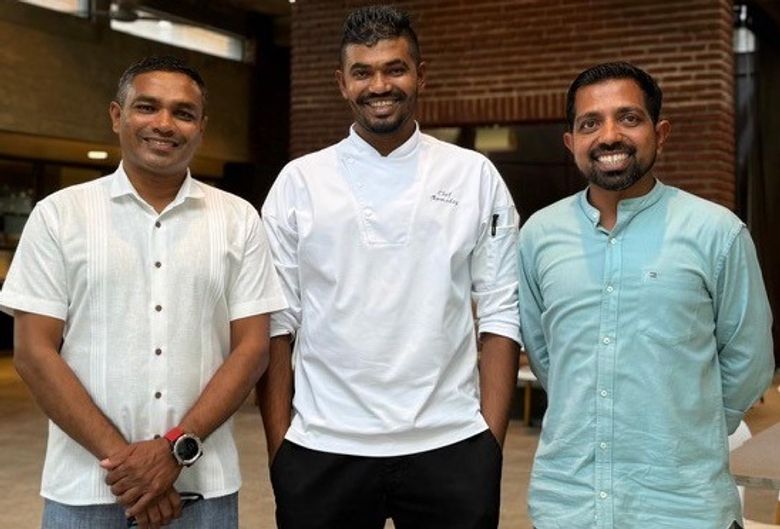
From left: Fari Campus HR Manager Hassan Rasheed, Head Chef Ahmed Rasheed and Campus Director Nawaz Ahmed
The
investment on staff living is prescient. An on-going battle to hire and retain
talent is becoming grueling for luxury hotels as new supply in the next few
years is coming mainly from this segment. A second JW Marriott has just opened.
Upcoming openings between 2025 and 2027 include Nammos, Bvlgari, Corinthia,
Mandarin Oriental, Baccarat and Rosewood – brands that have higher manning
ratios to deliver a highly personalized guest experience.
One
would think there's a huge pool of locals willing to join the tourism industry.
But a survey by Maldives-based People First HR Consultancy shows a disturbing
finding: the industry needs around 78,000 employees by 2027, on top of the
current 20,000. But the number of locals entering the workforce by 2027 is less
than 19,000 and not even 2,500 are expected to join the country's number one
income earner.
Maldives
encourages local employment by setting a quota of 45% Maldivians and 55%
foreigners at resorts. Yet it appears hotels, likely out of desperation, are
flouting the rule, with foreign workers forming 59% of the workforce in a 2022
survey by the Maldives Bureau of Statistics. Last month, the Maldives
Association of Tourism Industries urged the government to raise the foreign
worker quota to 70%.
A
key reason for the staff crunch has to do with location and living conditions.
Not all locals work in resorts nearby the capital, Male, or their atoll's
capital island, where staff ferries can take them home daily. Hiring a
10-minute speedboat ride typically costs around $80 per person depending on
location, shared transfer or private boat. So, like their foreign colleagues,
these employees tend to go home annually.
“I’ve
worked on islands in the Maldives where staff accommodation was very cramped
and there wasn’t enough space to safely and respectfully accommodate everyone” said
Anthony Gill, general manager of Patina Maldives, Fari Islands. “I know many
people can’t survive the living condition, or the fact they are stuck on the
island all the time – they walk five minutes to work, five minutes back after
work, then shower and go to bed – like that every day.”
In
comes the Fari tale
Envisioned
by Evan Kwee, third-generation offspring of the Kwee family that owns Pontiac Land,
Fari Campus appears to trigger a rethink of staff living conditions in the
Maldives. It has received many requests for viewing, including from a Turkish
developer who is opening a luxury resort in the country, according to Nawaz
Ahmed, the campus director.
Viewers
will see a verdant island where staff accommodation isn’t your typical big
nondescript block but spread out in three clusters of three-story buildings,
each cluster with a courtyard. Currently, there are 13 buildings and more than
400 single, double and four-sharing rooms.
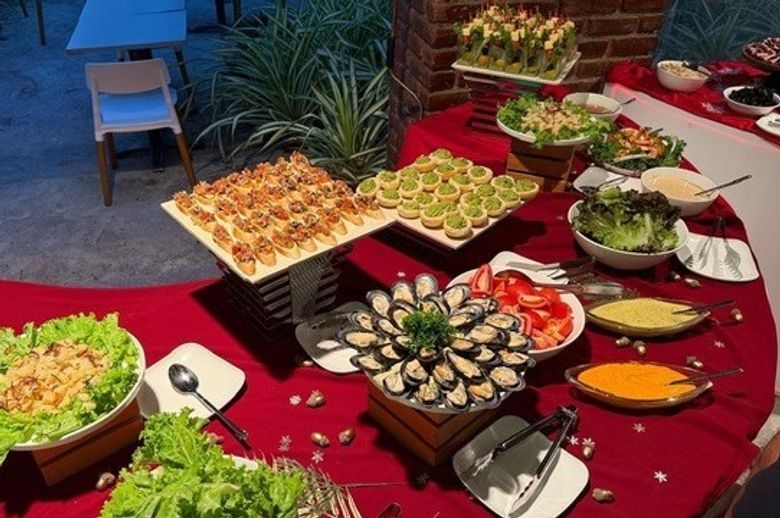
Buffet at Fari Campus staff restaurant
Rooms
have attached toilet and shower, plus WiFi. But 'living' isn’t just work,
shower, sleep, repeat. Facilities include a fully equipped gym (with a view),
yoga deck, recreation room for multimedia games, billiard and table tennis,
staff restaurant, function room, training rooms, beauty salon, clinic and
retail store. There's even a mosque. And a full-size football pitch, volleyball
and basketball courts, and yes, a beach (with beach beds) for staff –
paradoxically a rarity in the Maldives.
Beyond
housing, developing next-gen hoteliers is another key purpose of the campus.
Pontiac Land partners with EHL to seed young talent on the ground at the campus by
offering ambitious candidates three-year EHL-certified diploma courses
combining classroom learning and on-the-job training.
“This
initiative not only creates a skilled workforce for our two resorts, but
valuable employment opportunities, contributing to the well-being of local
families and the broader community,” said David Tsang, CEO of Pontiac Land
Group in Singapore.
The
company declined to discuss CapEx and ROI of Fari Campus, but Tsang explained
an intangible benefit: “We believe that when our employees thrive, so does our business.
This approach has resulted in increased productivity, improved job performance
and exceptional guest experiences. In fact, the effectiveness of Fari Campus is
evident in the remarkable achievement of both Patina Maldives, Fari Islands and
The Ritz-Carlton Maldives, Fari Islands earning the prestigious Forbes Travel
Guide Five-Star rating in their very first year of operation [2022].”

By investing in holistic community development, we’ve created a thriving ecosystem where employees and the local community can flourish together. Fari Islands has further crystalized our approach to property development, prioritizing holistic planning and long-term value creation.
David Tsang
Campus
management
Rather
than handing over Fari Campus to a facility management company, Pontiac Land
Group created its own in the Maldives with an additional 176 local jobs
managing areas such as housekeeping, laundry, food catering, security, et
cetera, just like in any other resort. A third-party company might just focus
on the logistics, not building a community with a sense of belonging and
kinship.
But
how does Fari Campus pull together nearly 1,200 people of 48 nationalities
working for three different brands under one roof? Won’t there big and petty
tensions, say, staff loyalty to their respective brand and sense of
competitiveness? Or staff comparing notes on benefits and entitlements of each
brand, creating new demands?
Nawaz
said at Fari Campus, everyone is treated equally, whether they are from
Ritz-Carlton, Patina or campus staff. It’s the diversity that makes the place
unique, interesting and, indeed, inclusive, he said.
“If
it’s Australia national day, there will be Australian dishes. Everyone
celebrates together and there are lots of gatherings – karaoke, movie nights,
outdoor screenings of sports tournaments [at a plaza], you name it.”
The
campus HR manager, Hassan Rasheed, looks after community-building, recreational
programming and the wellbeing of all staff. Issues such as hotel benefits,
training and development, payroll, should they arise, are handled as usual by
the respective HR director of the two hotels. Both reside in the campus, along
with department heads, assistant managers and rank-and-file staff.
So,
what's his biggest challenge as campus director? “Fari Campus is like a resort,
but the guests are the staff. My biggest challenge is to manage these guests
because staff who serve high-end resorts have higher expectations,” said Nawaz,
laughing.
Impactful
developments go beyond physical infrastructure, said Tsang, when asked about
the biggest learning from Fari Campus for the group.
“By
investing in holistic community development, we’ve created a thriving ecosystem
where employees and the local community can flourish together. Fari Islands has
further crystalized our approach to property development, prioritizing holistic
planning and long-term value creation.”